
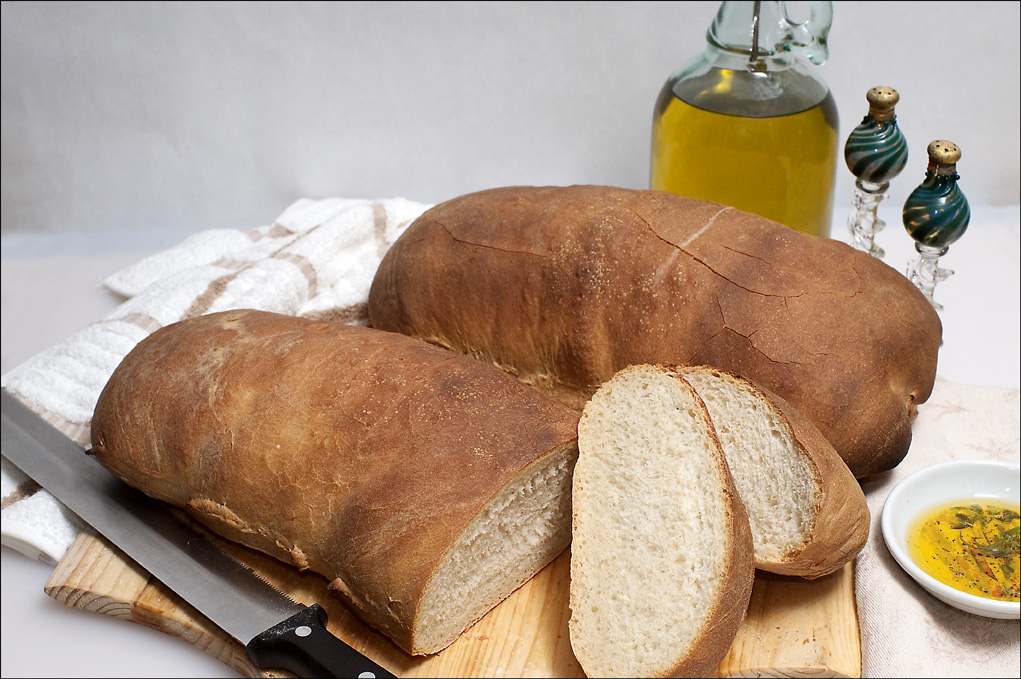
Fresh Ciabatta Loaves
It seems like eons ago when I use to make and bake bread three or four times a week. A key motivation for all that carbohydrate was not my own carb lust, but that of my children, and especially my young growing teenage son’s voracious appetite. Since then he’s gone away to school where, I’m sure, he is eating them out of house and home. Now, Rosaria and I manage to get by on a loaf of bread a week or less. But the other day, I had a hankering for fresh bread, and our daughter was home, so about mid morning I started a dough which I baked before dinner, resulting in two hot, golden ciabatta loaves.
Here’s how I made them. First of all you need some biga. You all know what biga is, I assume. If not, biga is basically a starter, or sponge. I make some and freeze it so I can use it anytime after defrosting it for a couple of hours. It’s real simple to make and it adds another dimension to bread. The only hitch is that if you’re starting from scratch, you need to make it the day before you plan to use with bread dough.
To make 3 ½ cups (750 g.) of biga:
½ tsp of dry active yeast
¼ cup of warm water
1 ¼ plus 2 Tbsp of room temperature water
3 ¾ cups (500 g) unbleached all purpose flour
In a mixing bowl stir the yeast and the ¼ cup warm water together and let it proof (until it becomes creamy) for about ten minutes, then add the remaining water and sift in the flour. I use the paddle tool on my Kitchenaide mixer, set on slow, and mix for several minutes. Put the biga dough in a lightly oiled bowl, cover it with plastic wrap, and let it rise at a cool room temperature for 24 hours. After you use some of the biga you’re going to need to “feed it” from time to time. That’s real simple: take 1 part biga, 4 parts flour, 1 part water and mix together. Let the mixture sit at room temperature for 24 hours, then either freeze or use it for another loaf of bread.
To make Ciabatta:
1 tsp dry active yeast
5 Tbsp milk
1 cup plus 3 Tbsp warm water
1 Tbsp olive oil
2 cups (500 g) biga (from above)
3 ¾ cups (500g) unbleached all purpose flour
1 Tbsp salt
Combine the yeast and milk in a mixer bowl and allow it to proof for 10 minutes. Add the water, the oil and the biga. I use the paddle tool on my Kitchenaide mixer set slow and thoroughly mix until it is a smooth slurry. Add the flour and the salt, combine well. Switch over to the dough hook, and knead for 3-4 minutes. Transfer the dough from the mixer bowl onto a floured work surface and hand knead the dough briefly, forming a ball, and place it in a lightly oiled ceramic bowl covered with a damp towel. Set the bowl somewhere warm and let it rise for about two hours. (I put the bowl with my bread dough to rise on top of my hot water heater).
After the dough has risen, roll it onto a floured work surface and divide it in half (or into fourths for smaller loaves). Flatten each section by rolling into cylinders and stretching them out into long rectangles. Before you roll the dough into cylinders is a good point at which you can add fresh chopped herbs in the dough as I did, like rosemary and thyme. Next, flour two or more pieces of parchment paper that are large enough to place the dough seam side down on each of them. I put the parchment paper with the dough onto a pizza peel but you can use a baking tray instead. Cover with a damp towel and let them rise for two hours.
Forty minutes before you’re ready to bake, preheat your oven to 425°. Put an ovenproof tray or your broiler pan on the floor of the oven. When the oven is hot enough, slide each loaf with its piece of parchment paper into the oven. I have an oven stone on which I bake everything. If you don’t have one, use a baking sheet or tray. Just before you close the oven door, toss a handful of ice cubes into the broiler pan; this will create steam and improve the ciabatta’s crust. Bake for 25-30 minute and then transfer the loaves to a wire rack to cool. There is nothing like the smell of fresh baked bread!
