
Here’s a great food presentation picture I shot recently.
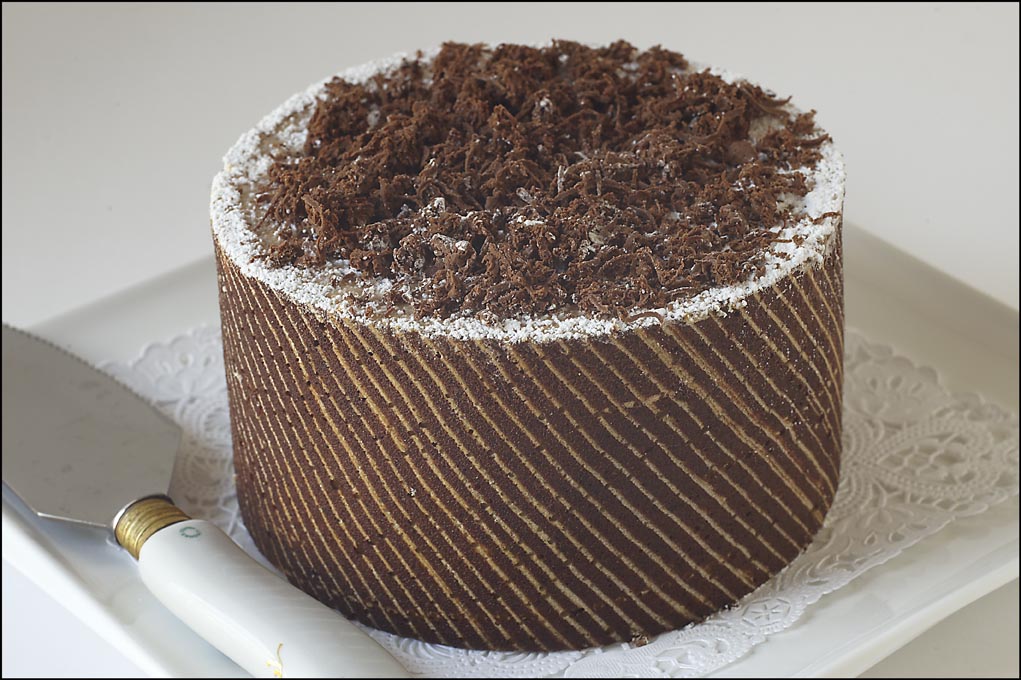
Charlotte with Chocolate Espresso Mousse
When someone invites us over for a lobster dinner at their house, get out of the way or we may run you over. Our friends Vicki and Ronnie asked us and another couple, Ginny and Ron, over for an impromptu lobster dinner recently. Naturally, I asked what I could bring and I suggested dessert. Vicki took me up on my offer. So what did I make?
Instead of a traditional cake, I decided to make a charlotte. A charlotte, for those of you who may be unfamiliar with it, is a molded dessert with a thin baked layer on the exterior which contains a typically cold, flavored mousse in the interior. Traditionally, ladyfingers have been used as the outer layer. Julia Child was the first to introduce me to making charlottes.
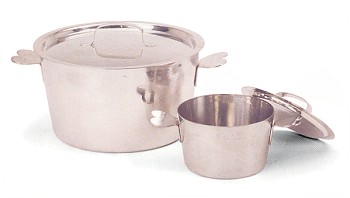
Charlotte molds
In fact, there are specific charlotte molds just for that purpose. To this day, I still enjoy piping out a batch of home-made lady fingers and believe me they’re nothing like what you buy in the supermarket. Over the past dozen or so years, I have researched and made a fair number of charlottes. I’ve consulted Rose Beranbaum’s Cake Bible for a lot of information, and I get particularly inspired by Bruce Healy’s The Art of the Cake: Modern French Baking and Decorating. For the lobster dinner, I decided to make a traditional French charlotte with a twist. Without getting into particulars about formula and recipe, I baked a thin bi-color, almond sugar based sponge on a full size Silpat silicone baking mat. After it cooled, I cut it in to a long strip about 24 inches x 3 ¼ inches, and lined a 6 inch spring form with it. I also cut two 6 inch circles for my bottom and center layer. For the filling, I made a chocolate-espresso bean infused mousse that had some gelatin in it, and spooned it into the lined mold until it was half full, placed the second round sponge layer inside, and continued to fill the lined mold until it was full. Then I placed the filled charlotte in the freezer for several hours to set hard. Before we were ready to go over to Vicki and Ronnie’s house, I carefully unmolded the charlotte and sprinkled it with confectioner’s sugar and some freshly shaved Gianduia chocolate on top of that.
When we walked into their house with my charlotte, both Ronnie and Vicki’s eyes lit up, and after a great lobster dinner, when I served individual pieces of my dessert, I was surprised and pleased to hear Ginny remark that it was the best dessert she’d ever had. You tell ’em Ginny!
RMA

7 comments
This IS gorgeous! I’ve always wanted to try this technique, but I’ve never felt that I could get it to work the way I wanted it to. Very impressive!
Thanks. I’m flattered that you’re that impressed. Actually the technique to make the charlotte casing is pretty straightforward, the problem is you need a full size baking sheet and silpat, a full size oven, and a large freezer space that will hold the full size baking sheet.
Robert
This is a beautiful cake. I am not a fan of anything that is coffee flavored so I’d probably leave the espresso out. 🙂
Or simply substitute a different mousse filling.
Thanks,
Robert
What a lovely charlotte! Wow. I wish I could have seen the inside. 🙂
Thanks! The mousse was gorgeous, a light mocha color, and it tasted even better than it looked.
Robert, this cake looks amazing! I would love to see the recipe.