
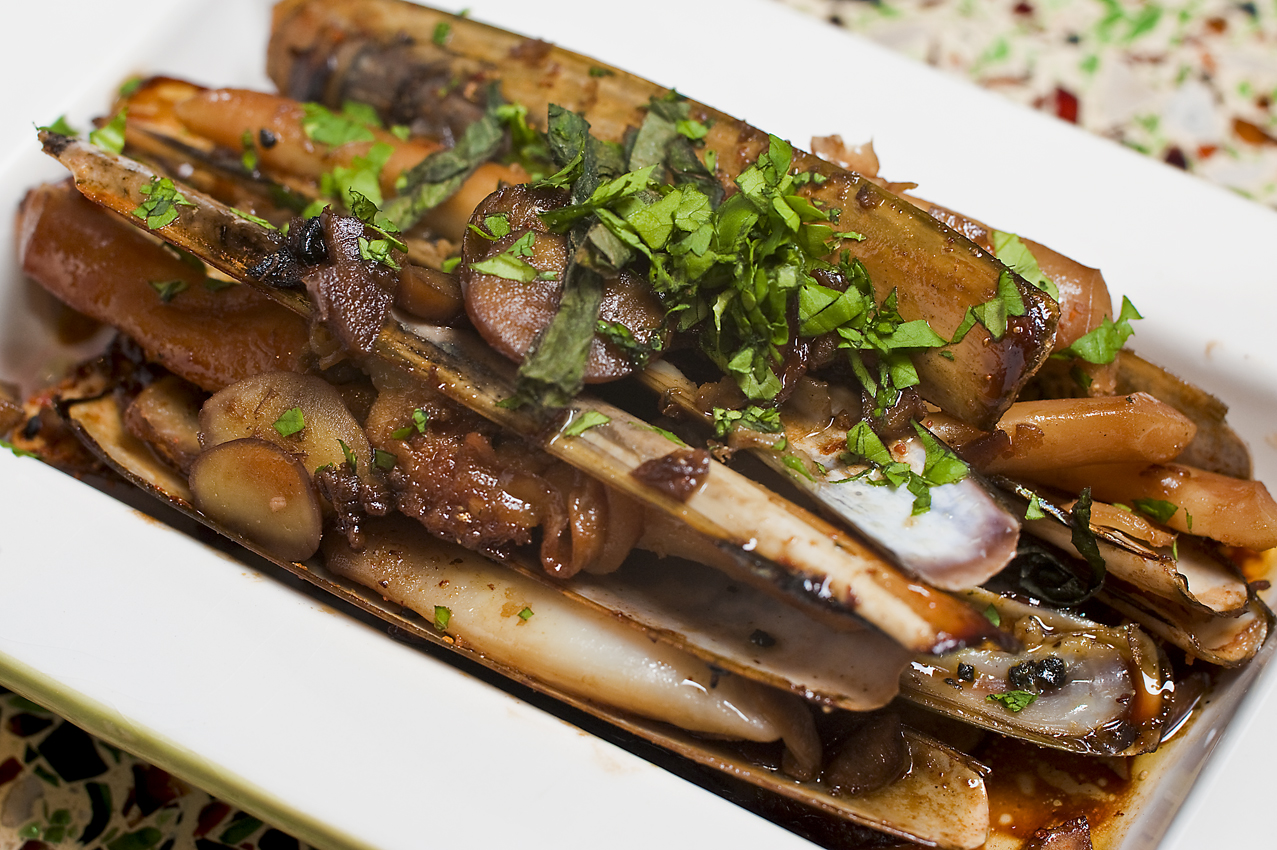
Razor Clams with Sliced Chestnuts
Prior to cooking and eating razor clams* (Ensis directus), or mussels (Mytilus edulis), I always indulge my mollusks in a pre-cooking treat: for the razor clams, I either soak them in a briny bath of salt water for an hour or so (30 g. salt to each liter of cold water) or I let them lounge on a bed of kosher salt in a tray for an hour. For mussels, I dunk them in a large bowl of water mixed with a small scoop of flour for a couple of hours. The goal is to purge the mollusks of sand and grit, and in the case of mussels, the flour seems to plump them up a bit. Also watching the razor clams extend their rather phallic clam thingie in and out of their shell in response to the salt can be visually entertaining, if not appalling to some of my dinner guest who previously haven’t had the pleasure of live razor clams. It’s always a hit with small children.
Recently, I had a simple dinner for just the two gourmaniacs of sautéed razor clams and poached mussels over udon noodles in a fish court bouillon sauce.
Razor Clams (2 servings)
Ingredients:
12 live razor clams
1 large clove of garlic
3 tablespoons olive oil
3 tablespoons Sake
½ tablespoon light soy sauce
6 packaged chestnuts, thinly sliced (already cooked and peeled)
¼ cup finely chopped cilantro
1 teaspoon shichimi tograrashi (Japanese 7 spice-can substitute hot Hungarian paprika)
Method:
This is a quick and easy dish to make once you open and clean the razor clams. Ordinarily, I purge my razor clams and then poach/steam as you would mussels. Here, I sauté them on the half shell. To do that, one of the two shells must be removed first. I find the easiest way to do that is to run a sharp paring knife blade up the back side where the clam shell is hinged. You’ll meet resistance where the clam is actually attached inside its shell. Turn the clam around, and cautiously open it up like a book, careful not to break the delicate shell. Take the knife blade and run it under the clam on both shells, careful not to completely dislodge it from the shell where it is attached. Lob off the bulbous head at one end of the shell and carefully slit open the stomach about midway down the clam. Inside is grit and sand which you want to thoroughly scrape out and flush with running water. Any leftover grit will be an unwelcome accompaniment while otherwise enjoying your sautéed razor clams in a few minutes hence.
Once you’ve opened and cleaned the razor clams, pat the outside of the shells dry with a clean towel, and make sure you have all the other ingredients all set to use. Over low heat in a large sauté pan, infuse the sliced garlic in the olive oil until the garlic just begins to color. Remove the garlic and turn up the heat to high. Once the oil is hot (not smoking) add the razor clams, shell side down. Sauté for a minute to a minute and-a-half, then turn each one over so the clam body is facing down. Add the sake and soy sauce and continue to sauté for another minute. Toss in the slivered chestnuts and turn off the heat. Take pre-warmed plates and divide the razor clams on to them. Top with the chopped cilantro and drizzle with the sake and soy sauce from the pan. Sprinkle the shichimi tograrashi over the razor clams, and serve immediately.
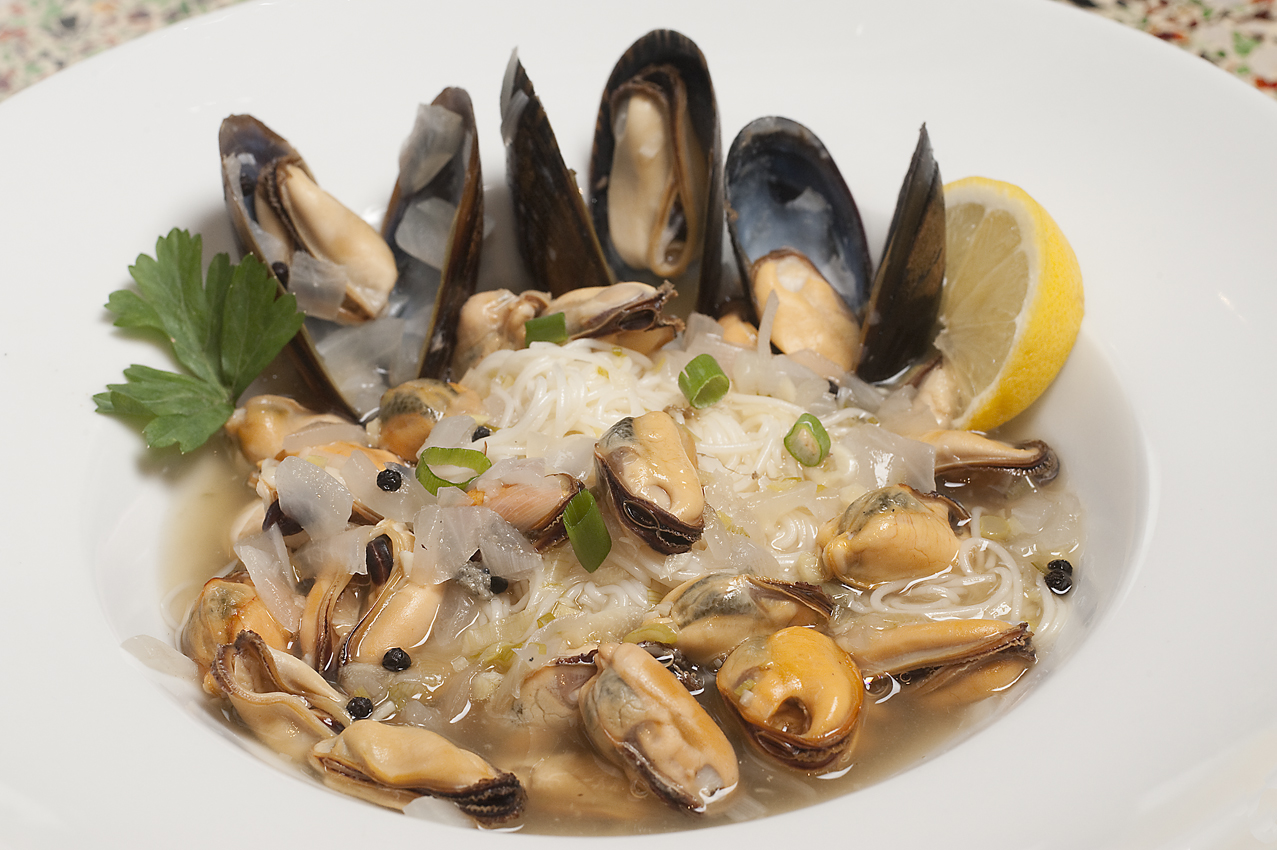
Mussels & Udon in curry leaves infused broth
Mussels and Udon Noodles (2 servings)
Ingredients:
3 pounds P.E.I. mussels (Prince Edward Island)
½ medium onion roughly chopped
3 bay leaves
6 whole black peppercorns
½ cup white wine
2 cups fish court bouillon, or fish stock or clam juice, or broth from cooking the mussels
2 sliced scallions white and light green parts only
6 dried whole curry leaves
3 tablespoons Vietnamese fish sauce
1 tablespoon Mirin
3 tablespoons parsley
2 “bundles” of packaged Udon noodles (a package of Udon noodles usually has a half dozen small “bundles” of noodles individually banded by colorful paper bands: this makes proportioning and handling simple.)
Method:
It looks like a lot of stuff to get together, but it really isn’t, and once you do, the process only takes about five minutes. First for the noodles, fill a small stockpot 3/4 full with water, add 3 tablespoons of salt, and bring it to a boil. Add the noodles for just a few minutes, drain and rinse with cold water, and set aside.
In another pot, bring to a boil the court bouillon or whatever broth you’re using, and reduce the heat to a simmer. Add the scallions, curry leaves, fish sauce and mirin and continue to simmer.
In a large stockpot, put the onions, wine, bay leaves and peppercorns and bring to a boil. Toss in the mussels and cover with a lid. Cook the mussels until they all open, about four minutes.
Drain the mussels. Reserve the broth if you’re using it for the noodle stock (and now add the sliced scallions, mirin, soy sauce and curry leaves and return to s simmer on the stove), otherwise discard.
Although you don’t have to, I find it’s easier and less messy to eat the mussels and the noodles if you remove the mussels from their shells, and add them to the stock right before serving to keep warm.
Take two pre-warmed bowls and divide the noodles between them, add the mussels and some of the fish stock with scallions (omit the curry leaves). Garnish with some parsley and/or thin scallion rings, a twist or two of fresh ground black pepper, and serve while hot.
* At low tide the position of the Atlantic jackknife clam [sic] (razor clam) is revealed by a keyhole-shaped opening in the sand; when the clam is disturbed, a small jet of water squirts from this opening as the clam starts to dig. This species’ remarkable speed in digging can easily outstrip a human digger, making the clam difficult to catch. Thus the species is not often commercially fished, even though it is widely regarded as a delicacy. The easiest way to catch jackknives is to pour salt on the characteristic breathing holes. The clam will try to escape the salt by coming up out of its hole, at which point you can gently grab the shell and pull it out of the ground. [wikipedia]
RMA
