
 Recently, Rosaria titillated us with her account of our wine tasting event the other night. She also wrote that we stayed and had dinner with our friends after the wine tasting. Without going into details about the meal, I will mention that I had handmade pappardelle with chanterelles, porcini, and oyster mushrooms. I’ve made hand cut pappardelle for years, but what I’ve never done was hand roll the pasta dough first. Not long ago, I was revisiting Giuliano Bugialli’s cookbook (who I affectionately refer to as ‘Bugs’) for pressed veal breast, and I ran across him hand rolling pasta. Among the many things I like about Bugs is his in-depth historical research on classical Italian cuisine. (For example, the stuffed veal breast came from a Florentine Renaissance recipe from the 16th century). If you stop and think about it, people were making pasta long before pasta machines and pasta attachments for KitchenAid mixers.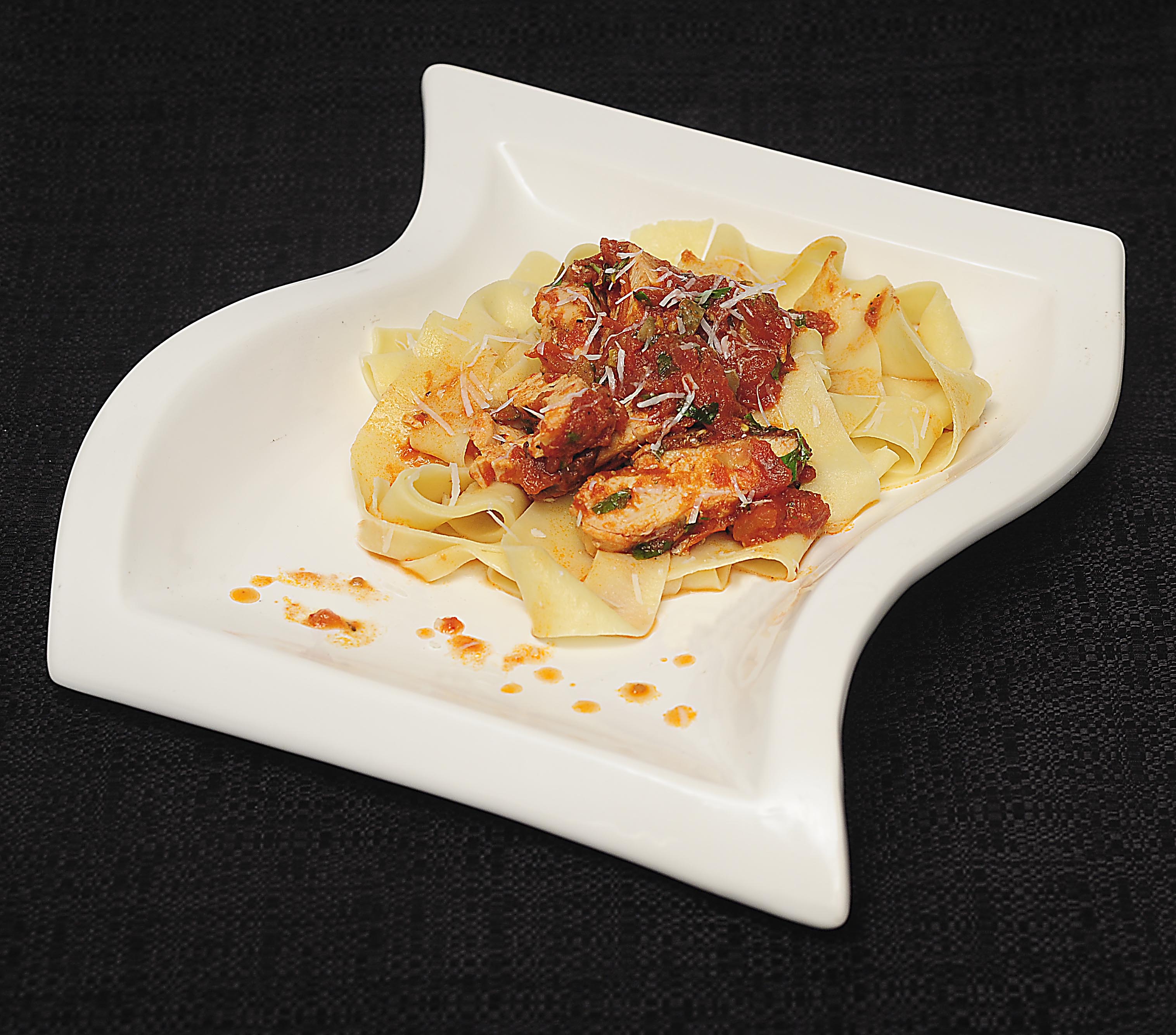
So last night, I told Rosaria that I was going to make hand rolled, hand cut pappardelle. Naturally, I didn’t get any resistance from her. The only discussion point was the sauce: I was thinking chicken stock and wine reduction from the bricked chicken I had made earlier, and she insisted we use our leftover Puttanesca sauce that had been hibernating in the refrigerator for a week. We went with the Puttanesca sauce and sliced bricked chicken over the freshly made pappardelle.
Here’s what I did for the pappardelle:
3 ½ cups of unbleached flour
3 whole eggs
2 egg yolks
(I can hear it already…’why didn’t you make the dough by hand instead of using a food processor?’ Because I was in hurry and excited to get to rolling out the dough – literally. I’ll have a blog about hand kneading pasta dough soon).
Put the flour in a food processor work bowl, add the eggs and egg yolk. Pulse the flour and eggs for 15-30 seconds until when you pinch the dough between you thumb and forefinger, it holds together nicely and it’s not too wet. If the mixture is too dry, add water by the tablespoon and pulse in the food processor until you get the correct consistency. If the dough is balling up on the processor blade, it’s too wet. Add more flour and keep pulsing until you get the correct consistency. When you’re satisfied with the dough, dump it out of the work bowl onto a counter or cutting board, gather it up into a ball, and compress it. It should be about the size of a softball. (Resist the urge to start playing catch with it with your kids or your significant other). Wrap it in plastic film or cover with a damp dish towel, leave it on the counter and let it rest for at least an hour.
When you’re “ready to roll”, clear an ample space on your counter or use a large wooden cutting board. See the sequence of photographs below. They’re pretty self explanatory. First, flour your surface. Next, cut off a third of the dough and press it between your hands. Plop it down on your surface, flour it, take your rolling pin and start rolling it out like you would a pie crust. Roll it in all directions. After it starts to expand, pick it up, re-flour the surface and turn the dough over, flour it again and keep rolling. Obviously, it helps it you have a large pin. If you don’t, I urge you to get a thick dowel like what you’d use for a closet pole. It should be at least 24″ and straight. (Bugs rolls his whole dough all at once and uses a 40″ dowel). A small 12″ rolling pin from K-Mart is going to prove rather ineffective.
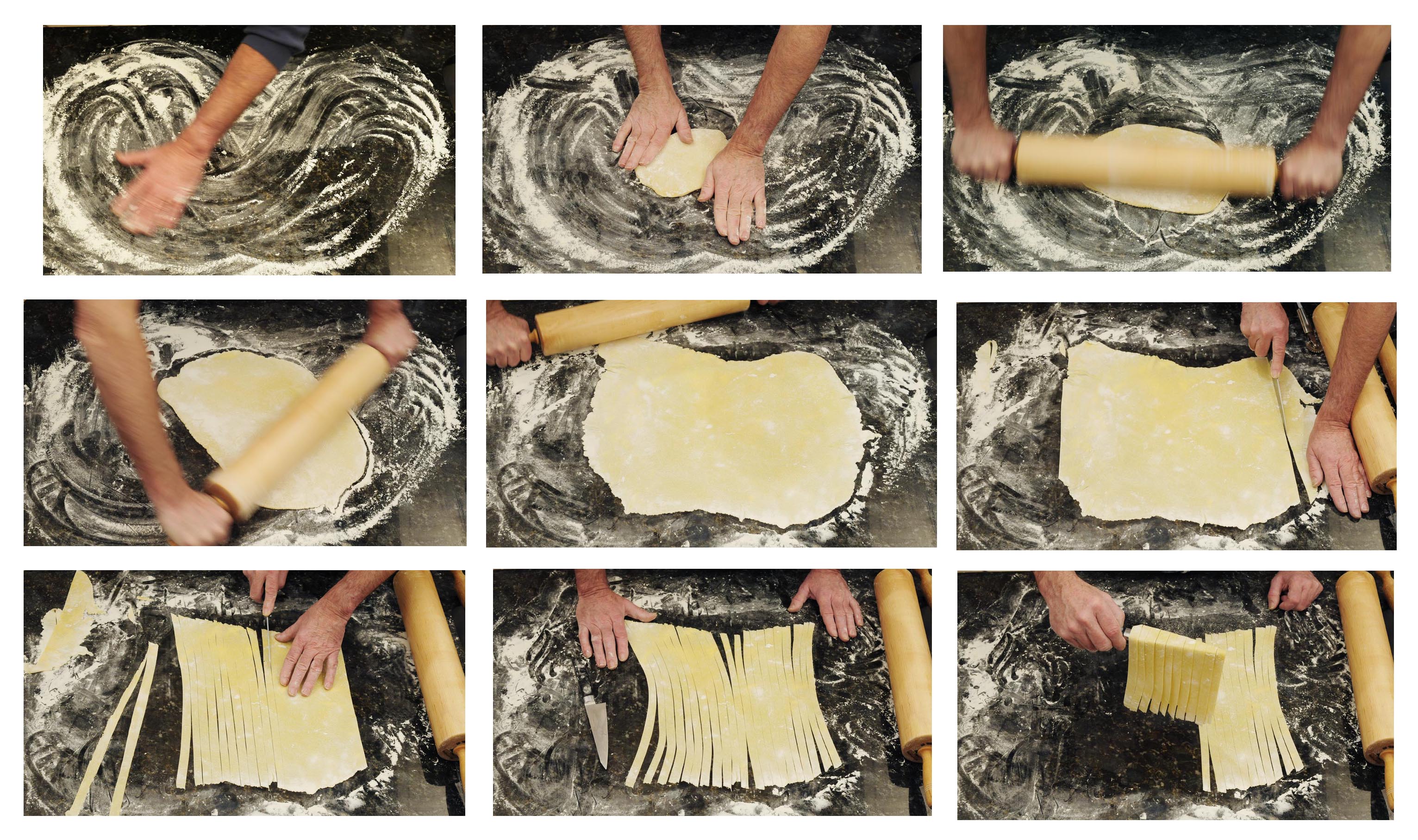
Once the dough is rolled out as thin as you can possible get it, 3/32 of an inch to 1/16 of inch, take a sharp knife and start cutting the dough sheet into ¾ inch strips. If you have a really sharp pastry crimper you can cut the strips with that to obtain a nice fluted edge to your pappardelle, something Rosaria calls “Margherita” because as a child she remembers having it often with Margherita sauce. It’s a ribbon pasta, consisting of flat strands that have wavy edges. My crimper was too dull, so no Margherita for us. Finally, when you’re done cutting, scoop up the pappardelle on your knife blade, and drape it over the wooden dowels of a pasta drying rack, or on the back of wooden chair, or on a broomstick suspended between two chairs (always my favorite, but Rosaria refuses to have that in our kitchen anymore). Hang the pappardelle there until you’ve finished rolling and cutting. It can hang overnight but if left there for more than several hours, it becomes brittle so be careful when putting it in the boiling water when you’re ready to cook it.

6 comments
Rand R
Pix r nice & recipes are good. My comment is that u should have pix of u actually cookin/ preparin and smilin: it should be fun. Recipes could be copied from anyone and just placed on internet. Show pix of u guys preparin. Would liven things up and show that u r cookin/ preparin. only found u by google not on internet explorer. tell me if u get my email. Mike
Robert this is a great post, very thorough with lots of visuals! O ya “Bugs” was a neighbor of ours in SoHo…we unfortunately never met.
Mike, you are absolutely correct, although we have to be mindful that the blog focuses on images of our food, and not of us. But your point is well taken so … stand-by for more pix of the “goumaniacs” soon. Thanks! R & R
Jeanne,
thanks a bunch for your comment. do you make your own pasta? Bugs was extremely important for me back in the ’80’s: through his books, he taught me not only about Italian cuisine, but about technique for Italian cuisine. I started revisiting him within the last year or so, and I am delighted that he still holds so much information for me. wonder what he does these days?
great post as usual!
[…] our hand-cut pappardelle, or your favorite packaged wide pasta according to cooking directions. Drain, divide into two […]