
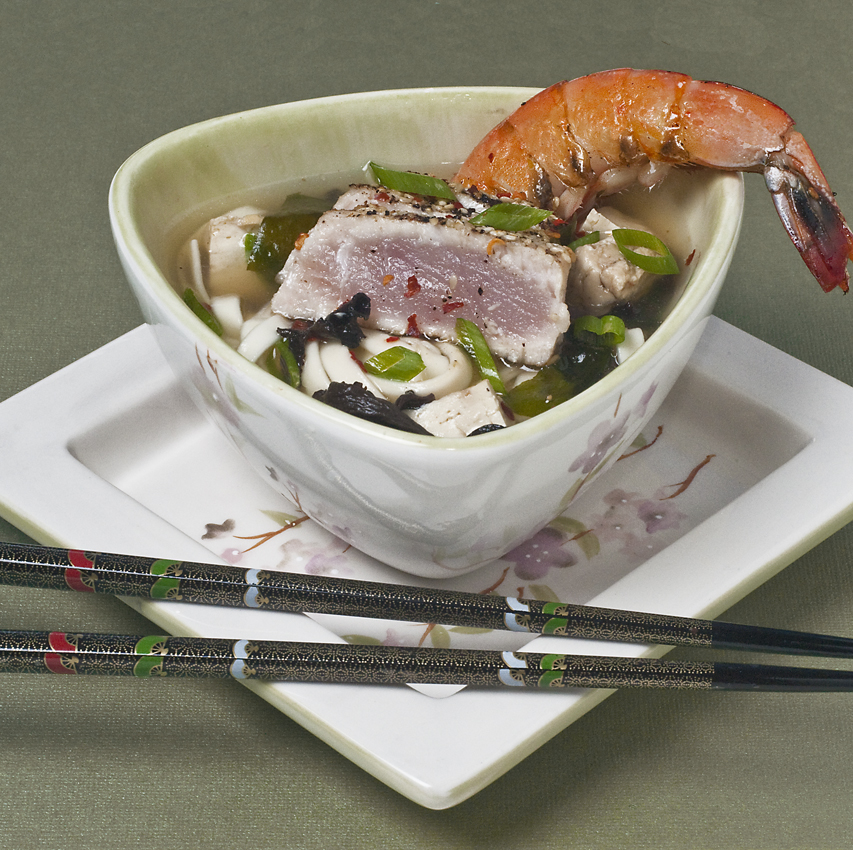
Pepper & Sesame Crusted Tuna with Tofu, Black Trumpet Mushrooms & Shrimp over Udon Noodles in Dashi
It’s the story of my life: as soon as I get into something, develop an ability for something, buy or acquire something, that something becomes unavailable, obsolete or not the thing it seemed to be in the first place. Take Japanese haute cuisine as a case in point. Within the past year I’ve delved into fine Japanese culinary art. My first introduction was by way of Nobuyuki Matsuhisa who revealed to me a lot more than sushi and sashimi rolls or tempura. And forget the Tokyo version of Iron Chef: that’s all smoke and mirrors compared to traditional Japanese haute cuisine. The concept of cha kaiseki or cha kaiseki ryori which emerged in the 16th century was based upon an older culinary tradition dating back to the 8th century. In a sentence, the concept is that all five senses are engaged during a meal (sounds familiar when you consider Ferran Adria or Grant Achatz). And embracing the season is paramount, not only in the use of ingredients, but the decor of the room in which the meal is served, the very room itself.
Universally important, and exhaustively discussed in Japanese culinary literature is the fifth taste sense, umami, first identified in 1908 by Professor Kikunae Ikeda. In addition to bitter, sweet, salt and sour, umami is the taste best described as savoriness. And the most important Japanese vehicle for this taste is dashi. Without getting into a dashi treatise, let me suggest that dashi is the Japanese equivalent of chicken stock in the Western kitchen. It is used in a great many dishes; and there are numerous different dashis as well as different grades of dashi. As you probably already guessed, preparing dashi is a Japanese art form.
Traditional Japanese dashi seems simple enough, there are three ingredients, konbu ma (a special kelp like seaweed), bonito flakes (shaved bits of specially dried and preserved bonito) and water. You first simmer the konbu ma in hot water, remove it and add the bonito flakes until they sink to the bottom of the pot, and you’re done. Easy. Of course there are a myriad variations, especially when it comes to the qualities of the konbu ma and the bonito. Location is everything, especially for the konbu: the waters off northern Hokkaido island are the mother lode, and each cove or inlet has its own sought after konbu cultivation. Even the drying and preserving takes on a fussiness closely aligned with french wine making.
As deceptively simple as making dashi seems, finding konbu ma and bonito flakes has become something like the holy grail search for me. I found a packet of konbu and some bonito flakes at my local “Wild by Nature” store. When I made dashi from it, the taste was reminiscent of Japanese soups or “hot pots” I’d had at Japanese restaurants, but, let’s just say, I wasn’t bowled over by it. In Manhattan, you’d think you’d have plenty of Japanese food resources. Not so. There are a lot of Chinese markets, India spice stores, even Southeast Asia speciality food stores, but not many Japanese stores. I finally found Sunrise Mart, which is on a second floor accessible by elevator. They had a decent selection of seaweeds and konbu ma. There were several different grades of packaged bonito flakes. Of course everything was written in Japanese, but the staff was very helpful in assisting me with my purchases.
Ingredients are everything. Once back in my kitchen, I made premium dashi, also known as ichiban dashi. After straining the dashi, I tasted a spoonful. It was incredible. The appearance was like a very clear, slightly golden chicken stock. The smell was rich with a hint of smokiness. And the taste spread across my palate like high tide. I used it for brothy noodle soups, as a stock for a thin sauce, and I substituted it for chicken stock when making risotto. Next on my dashi bucket list is uni (sea urchins) in a dashi aspic. Dashi keeps well in the refrigerator for a couple of days, and freezes well.
But as I said when I started this post; “it’s the story of my life…” With the recent tsunami and earthquake tragedy in Japan precipitating the nuclear disaster, I wonder about the long term effect of the radiation in the ocean surrounding Japan, and the safety of consuming anything coming from the sea. For the moment I’m rationing my remaining konbu ma and bonito flake supplies.
Ichiban Dashi:
Ingredients:
20 grams konbu ma
80 grams dried bonito flakes
3 liters of water
100 milliliters of water
Method:
Take the dried konbu ma and gently wipe both sides with a damp towel to remove any dirt or dust. Place it in a pot with the 3 liters of water and heat it until tiny bubbles appear on the edge of the pan, or use a thermometer and bring the water temperature to 60-65 degree Celsius. You definitely do not want to boil it. Remove the kombu, add the 100 ml of water to maintain a water temperature of no higher than 70 degree Celsius, turn off the heat and add the bonito flakes. Skim any residue or scum from the surface. When the bonito flakes sink to the bottom of the pan, pour the dashi through a cheesecloth lined strainer, and cool to room temperature.
Reserve the konbu ma and bonito flakes separately. They can be re-used to make a #2 dashi which is excellent for soups.
RMA

2 comments
That sounds amazing (the ichiban daishi). In Hong Kong I think we have an obsession with anything Japanese so different bonito flakes and konbu ma is not hard to find at all.
You are hoarding konbu ma and bonito flakes; my parents are hoarding all the Japanese rice they can find. Haha.
My life story’s like that too; I like things that are rare/hard to find and then I delve into them and they are obsolete or just changed/upgraded/transition into innovation or thin air..sighs :p
I like Japanese food too, and I think the cuisine’s strong enough to withstand the test of time (or my like) 😉