
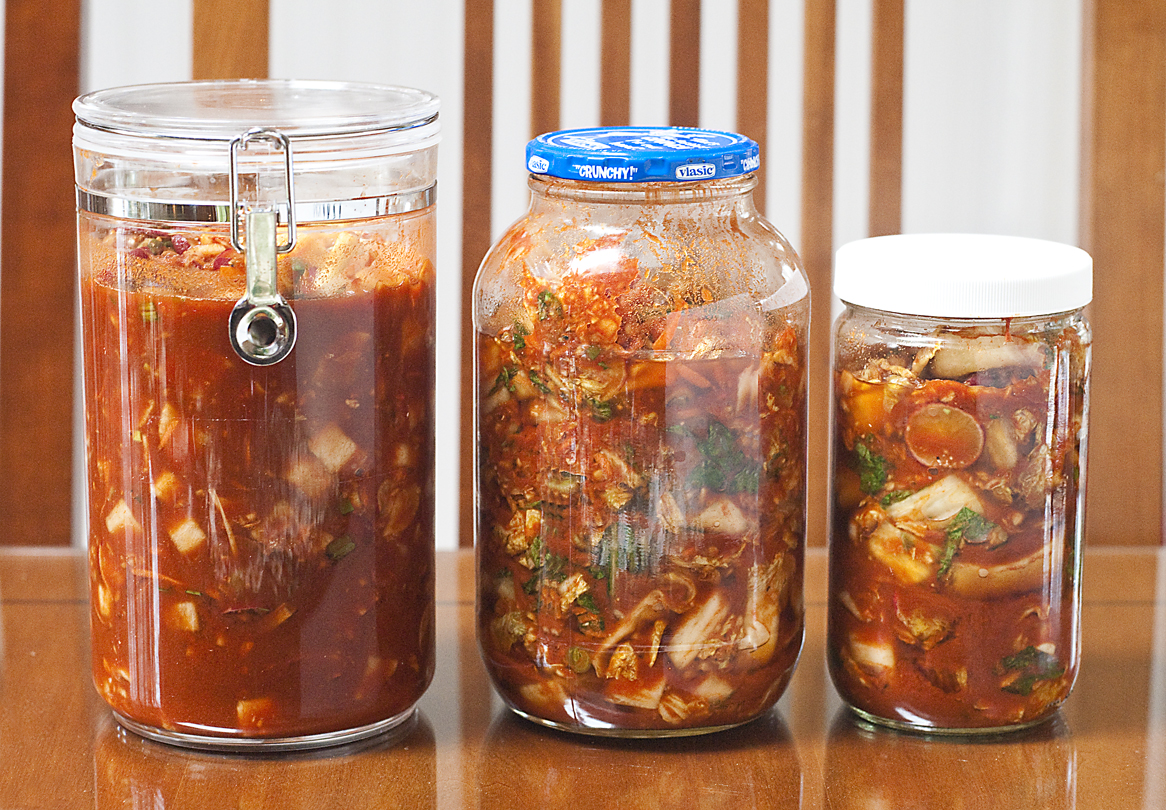
Daikon Kimchi on the left, Napa Cabbage Kimchi center and right
In my experience, kimchi is something you either love or you’re running from the room if someone offers it to you. Needless to say I fall into the “love it” camp; in fact, consider me the camp counselor. But that wasn’t always the case. My first experience with it was decades ago in a small coastal New England town where I lived. A friend of mine’s wife had picked up a jar of kimchi in Boston’s China town. My friend, in a not uncommon display of culinary bravado, started passing around spoonfuls of it at the local pub. I was overwhelmed by the huge blast of garlic and chili that flooded my mouth, laying siege to my unsuspecting palate. It seems I couldn’t get rid of the taste for a couple of days. At that time I definitely fell into the “I-hate-this-stuff” camp.
Fast forward a decade or so later when I was dating the other gourmaniac in New York City. She lived in midtown a couple a blocks away from “Little Korea” and she loved kimchi. She encouraged me to give it another shot. “Not bad,” I recall saying. “Definitely not my recollection of my first experience with it in New England. “
Since then, I’ve enjoyed kimchi in myriad ways, from Philly Cheese Steak subs (Newtown, Pa.) to various soups and as a starter in Korean restaurants, to the homegrown stuff in Seoul. Finally, a couple of years ago, I started making my own kimchi. Koreans traditionally make it in late autumn. I’ve made it in every season, but I take special pleasure in putting it up in November. The process is very similar to sauerkraut; basically you’re fermenting vegetables but with addition of very hot chili powder and lots of garlic.
Last week, I used the last of my kimchi as a base for a sauce that went over sous vide trout. It was unbelievable. So it’s time to make more. Here I make both traditional cabbage kimchi as well as daikon kimchi. This is my version of Chiang’s at Momofuku.
Ingredients:
1 medium head Napa cabbage
3 T. sea or Kosher salt
2/3 Cup + 3 Tbsp granulated sugar
3 Tbsp mirin
½ cup minced garlic
½ cup minced fresh ginger
2/3 cup Korean red chili powder (available in Asian grocery stores)
¼ cup fish sauce
1/3 cup soy sauce
1 ½ Tbsp salted shrimp from a jar (available in Asian grocery stores)
½ – ¾ cup scallions chopped, both green as well as white parts
½ – ¾ cup shredded carrots
6 red radishes thinly sliced
Method:
Take the head of Napa cabbage and discard any loose and discolored outer leaves. Cut it into 1 inch wide slices, take in half lengthwise. In a large bowl, combine the chopped cabbage and the sliced radishes with the 3 Tbsp of sugar and 3 Tbsp of salt. Cover, and refrigerate over night to leach out the water .
Next day put all the other ingredients except the carrots and the scallions in a medium size work bowl. Stir until well mixed. The mixture is probably going to be a little dense, so dilute it with water, half cup at a time until it is loose: usually one cup of water is enough. Add the carrots and the scallions and mix. Drain the cabbage and radishes in a colander. Return to their bowl and pour on the brine mixture from the other bowl. Mix really well. If you’re using your hands as I do, I strongly recommend wearing vinyl or latex gloves.
Note: I have a bag of several kilos of Korean red chili powder with a zip lock seal. If you are using a large bag of this stuff be really careful not to inhale any of the powder when you open up it up. Trust me on this one!
Cover the bowl and refrigerate overnight. The next day, take a taste, then transfer the young kimchi to large bottle(s) and stick them back in the refrigerator. Although it useable after 24-48 hours, allow the kimchi to ferment for a couple of weeks. After that, it becomes increasingly stronger as it ferments and the taste becomes much sharper, which I suspect is what happened to the kimchi during my first experience with it in New England.
For Daikon Kimchi:
Simply substitute the cabbage with four medium daikons, peeled, and chopped into ½ – ¾ inch cubes. Add a few more red radishes if you like. And after the initial overnight refrigeration of the mixture, I add 2 stalks of lemongrass that have been cut into thirds as I bottle everything, for some extra flavor zing.
RMA

2 comments
Funny, I am surrounded by kimchi! My sister and I just did a podcast on pickling and she made kimchi. I discovered a new Korean grocery in Chicago yesterday and picked up their housemade kimchi. And now YOU! It’s all good.
So good to hear from you Megan. My feeling is- you can never have too much kimchi. Enjoy and encourage others to give it a try.