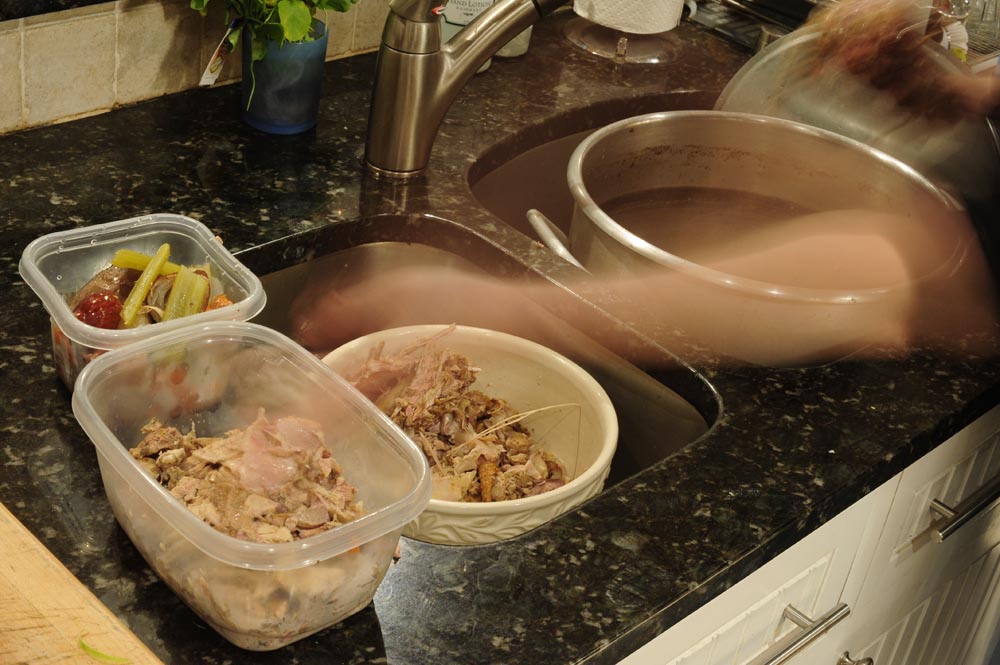
The day or so after Thanksgiving is a time when my cooking friends give me their well picked over turkey carcasses, delivered in various states of scavengery. It’s all the same to me. I just want the carcasses. Once I get them, I gather my ‘mise en place’ ingredients (see below) and fetch my large stock pot. As you can see from the initial photograph, I’ve got a couple of turkey carcasses which I affectionately refer to as racks.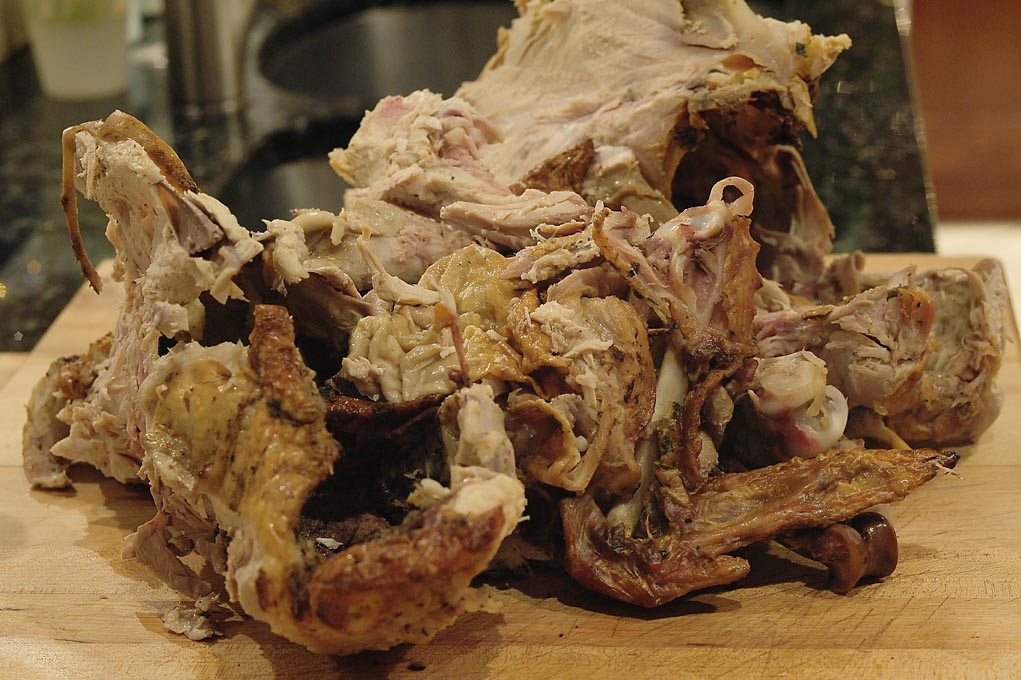 The first challenge is to break down the racks into much smaller pieces. With a whole chicken or duck rack, poultry shears or a stout kitchen knife can accomplish the task. Not so with your big twenty-plus pound Tom. A good cleaver is imperative for the job. For years I’d relied upon cheap cleavers which admittedly did an acceptable job with a lot of pounding and swinging. A couple of years ago, persuaded by our daughter’s friend Leah who was a Cutco sales rep, Rosaria got me a Cutco cleaver. It’s a great piece of steel, and if I am to believe the literature, it’s capable of delivering a razor-sharp blow of up to 100 pounds per square inch with a blade that never needs sharpening! The two pictured racks were reduced to pieces smaller than the palm of my hand in minutes.
So here’s what you do to make turkey stock based upon two turkey carcasses: (reduce the onions and aromatics by a half for a single turkey carcass).
~ 4 large yellow onions split in half perpendicular to the onion vanes (sections), unpeeled. Using red onions or 6-8 smaller onions is fine, with several whole cloves inserted into the cut side of each half (see below)
~ whole cloves (roughly 4 times however many onions you have)
~ 2 leeks roughly chopped (white parts only; save the leaves for vegetable stock)
~ 4 large carrots roughly chopped
~ 3 celery stalks roughly chopped
~ 6 garlic cloves, peeled and smashed (don’t be afraid to use the side of your cleaver)
~ 18 stalks of parsley, preferably with leaves
~ 3 bay leaves
~ 2 tablespoons of whole black pepper corns
~ cheesecloth and string
First prepare your turkey carcass(es) as described above. Next fill 3/4 of your stockpot with cold water, put all your turkey parts and pieces in it, and turn up the heat to moderate-high. With my stockpot it takes about 40 minutes to get the water with the turkey parts to a simmer. Be patient. In the meantime, chop your onions and aromatics, take a piece of cheese cloth about 12″ by 12″ and put the parsley, garlic, bay leaves, and peppercorns on it, roll it up making sure to tuck the ends like a spring roll or burrito, and tie it off with a piece of cotton string (no polyester or synthetics). Now is a good time to wash you cutting board and cleaver from the turkey bashing that you’ve just administered.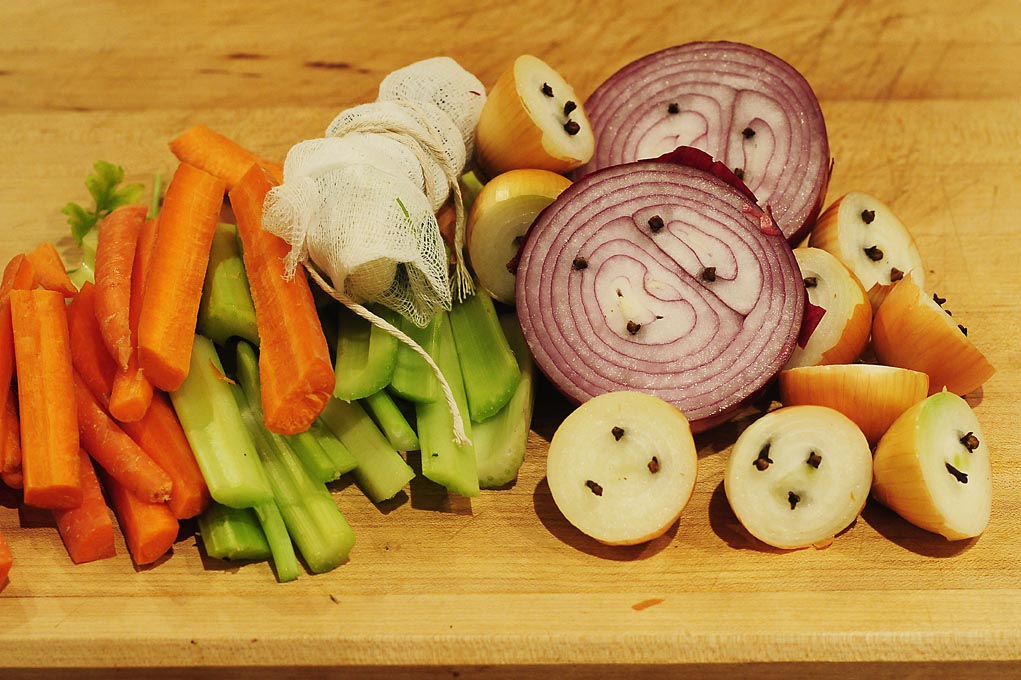
While all this occurs, you want to keep an eye on your stockpot as the water begins to get hot. You’ll notice a bubbly, frothy debris layer starting to come to the surface. That’s when you can begin skimming all of this detritus off. I use a fine mesh skimmer with a longish handle. You want to keep skimming as the water gets hotter, but nowhere near boiling. The more you skim, the clearer your finished stock will be. Once you’re satisfied that all the debris is out of the simmering stock, turn the heat down real low, incorporate all you aromatics, your bouquet garni (the cheesecloth “burrito”), place a couple of long-handled wooden spoons across the rim of your stockpot and place the pot’s lid on top of the spoons. Let this simmer for at least ten hours. I do this overnight as my stove has a simmer burner with very low heat. An option would be to use a heat reducer under the stockpot. It’s a round metal gadget that looks like a ping pong paddle, but is made of perforated metal, and gets placed between the fire and the pot.
Take a look at the before and after photographs of the surface of the stock. 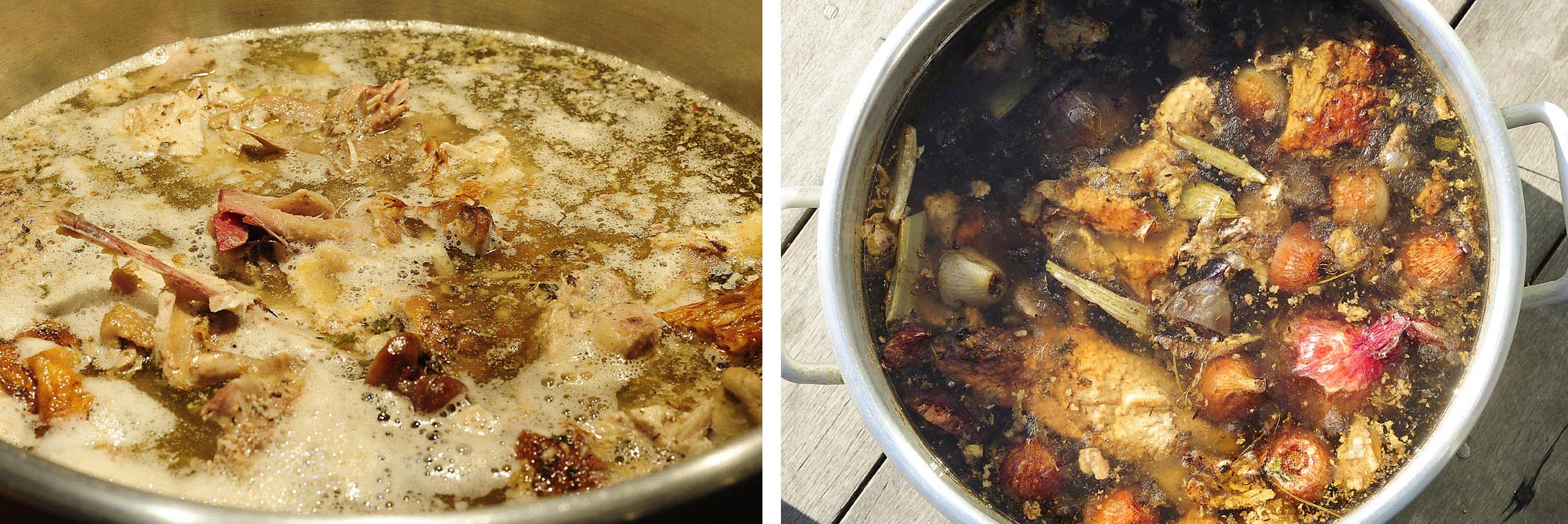 The first one is during the skimming process, the second one is after the stock is finished. It looks darker, richer, and it smells terrific; in fact the whole house smells terrific. Next pour off all the stock, or better yet, use a small sauce pan or a 4-quart measuring pyrex cup, and ladle the stock through a fine sieve into large bowls. After the stock cools to room temperature, put the bowl(s) in the refrigerator, ideally overnight. All the fat will be rendered to the top of the bowls, and it can easily be spooned off as a semi hard fatty layer. Put your de-fatted rendered stock into plastic containers and freeze for future use in sauces and soups.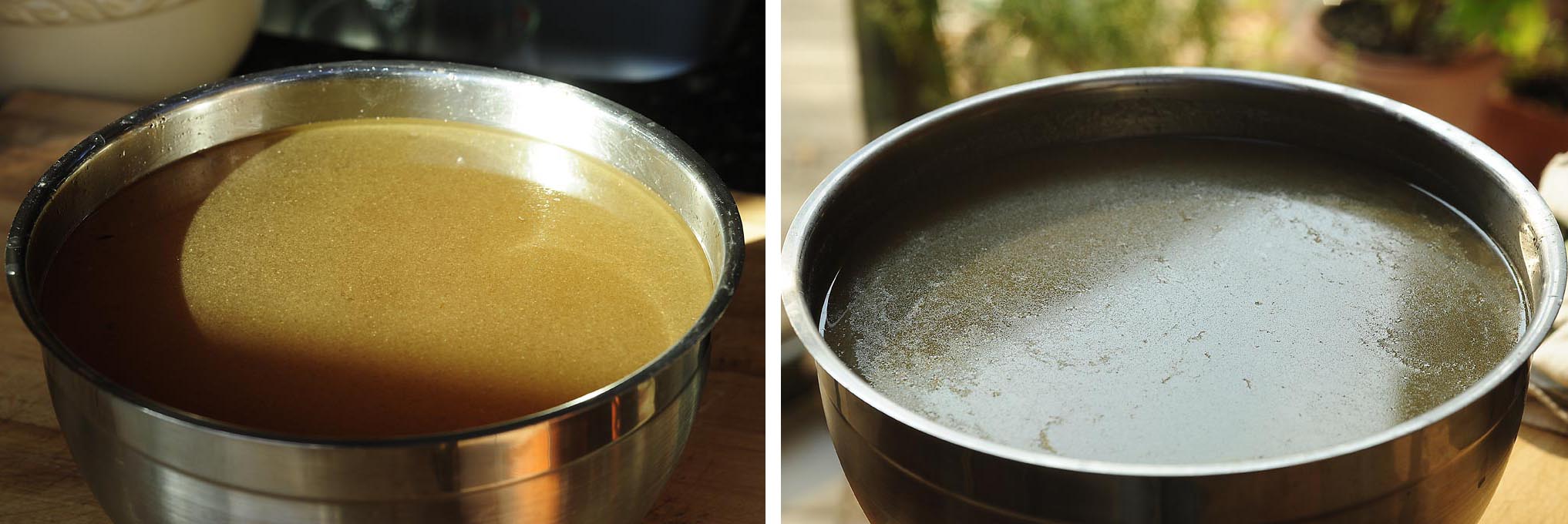
At 2Gourmaniacs, we try to adhere to the from “nose to tail” philosophy. So after the stock has been ladled off, Rosaria gets to hand picks all the meat off the turkey bones and saves all the vegetables. She either makes soup or sometimes turkey salad from the turkey meat. The vegetables can be used in soups, either chopped or pureéd and used as part of the soup base — in this case, turkey soup. Finally, when there is nothing left except the bones, I take them out behind the house and toss them into the woods where the raccoons and possums eagerly await their part of Thanksgiving dinner. I’m sure we have the best fed critters around.